
(This post has been serialised in the author's Cricket Country Column)
McCabe hooked Voce with a forked lightning stroke, and the crack of his bat was the accompanying thunder.
McCabe hooked Voce with a forked lightning stroke, and the crack of his bat was the accompanying thunder.
Grimmett’s arm, not above the shoulder, could toss a ball along an arch of wicked temptation, or send it along with a subterranean deceit.
While Ranji seemed to toss runs over the field like largesse in silk purses, Fry acquired them – no, not as a miser his hoard, but as the connoisseur his collection.
There were not enough fieldsmen available, Bradman found gaps and vacancies in nature.
This game could be laid up in heaven, a Platonic idea of cricket in perfection.

There were just a couple of volumes of Neville Cardus in The British Council Library of Calcutta during my student days, and for them I paid around seven months worth of college stipend in overdue fines.
Cricket had been my refuge, my vehicle of fanciful flights away from the rather harsh reality of a grim childhood. Anticipation of domestic disturbances or the growing frustrations of a misunderstood juvenile always found dissolving solace when one of the Indian maestros of the eighties, in proud spotless flannels, stood bravely at the wicket, negotiating the might of foreign fast bowling.
However, Cardus was the conjurer who converted interest into romanticism. I somehow seem to more vividly recollect a drive by Frank Wooley than a similar one by Allan Border, although I saw the latter in flesh and on screen, and the former hung up his bat and boots forty something years before my birth. Such was the magic of a Cardus piece.
Within maturity’s formative mould were cast the most scorching lines ever written about a sport, to leave an impression that modern day cricket writing has struggled against ever since, as a pretentious tail ender might have flaunted his extra cover drive going in at number three instead of the Don.
I grew out of my boyhood, entered working life, watched as much cricket as came my way, became an author. The days of familial friction grew distant in the rear view mirror of time. But, yet, a part of me remained unfulfilled, a part of my very being.
Dished with the modern day bushwhacked bilge that passes for cricket writing, where the metaphors of willow and leather are restricted to ‘Amir is bee, Asif is snake’, with grandeur of the English language pulled down to the levels of grammatical questionability as reverse sweeps, my soul yearned for Cardus in the covers.
And that is what I could not find. Neville Cardus classics were not available in book shops any more, a striking testimony to the devaluation of real riches in the glitz loving modern world in general and semi-literate shelf space in particular.
My work took me across the world to the United States of America , to the Netherlands , to Switzerland
Yet, not one of the countries I visited was a Test playing nation. Cricket bats were seldom recognized as instruments for the noble purpose of making runs, often mistaken as oars for kayaking. It is not that I did not find cricket books in these misguided states content with their fare of baseball and soccer . A bibliomaniac can at best be down, but not even the most enterprising of umpires can declare him out. A John Arlott here, a candid autobiography of Freddie Truemann there … but a Cardus catch eluded me. All I had was a copy of his autobiography, a most delightful and erudite study of his life and times, ordered online from a second hand bookseller.
With shelf, floor, sofa and other spaces giving out, crowding around me in protest against accumulating folio, I had acquired a Kindle. But, the gems that I sought were not available in the electronic gold mines either.
So, when the trip to Blighty was fixed on an impulsive evening after Tendulkar hooked Stein for six to bring up his fifty first test century, I saw my unflinching target for the tour in my mind's eye. I would scour the length and breadth of the land if necessary, but come back I would with my Cardus booty. Surely, in some nook and cranny of the Old Country would stand some of the glorious books in splendid oak shelves, waiting for my hands to fall on them, ending a wait of two decades.
And thus began the chase ...
********************************************
The hunt begins before the ship docks in Harwich. On the Stenaline boat, I login to the internet and search deep and wide to draw up lists of cricket book shops.
The immigration officer learns that I will be staying back for almost two more weeks after the departure of my wife and kid. “Why?” he asks. “I will be going to two Test Matches,” I reply, slightly uncomfortable. It is perhaps the combination of professionalism and good natured hospitality that keeps him from smirking or countering with a jibe. Indians on the tour have not really done us proud.
The first night in London
At one end of the spectrum are a few who consider it a game played on the greens, by men in white, by artists who produce masterpieces in motion. Who profess, in the words of Cardus that –“(for) the great batsman … the bowling is his material, and out of it he can, if he be a Woolley, carve beauty before our eyes, beauty that is characteristic.”
And the other extreme is crowded with ones who believe in painted performers emerging from dug outs, who gyrate in beat to the pelvic thrusts of the cheer leaders, who pay homage to the game around the sacred fire of burning effigies.
At yet other corners of the ‘cricket loving Indian space’ are the self appointed social commentators, arm chair proletariats, who convert their own frustrations of ordinary life into righteous indignation at the endorsement riches earned by the living legends of the game through the sweat of their brow.
Suvro shows me a replica of the Ashes urn from the museum at SCG. He presents me with invaluable Bradman memorabilia. I know I have found an ally who will crouch close to the wicket as I try to snare out Cardus. I ask him about the master, and he points me to Blackwells at Oxford
I leave their Rainbow Quay flat in the morning, having borrowed Sujit Mukherjee’s Autobiography of an Unknown Cricketer for the long train journeys. Not found in Indian bookshops, the works of this late professor of Patna University
*
 |
| My daughter and I recreate 6 sixes of Sir Gary |
After a rainy day spent at the Jane Austen centre of Bath we reach Swansea. I visit the St Helen’s cricket ground. It was in the older version of this picturesque ground overlooking the North Sea that in 1968 Garfield Sobers, playing for Nottinghamshire, hit the Glamorgan spinner Malcolm Nash for six sixes in an over.
In Swansea I hear about the riots that have broken out in London
*
The country side of England
Onward we walk, feeling the ripe contentment of England in summer time everywhere. And now we are visited by extreme bliss: the lane makes a curve – a gesture of invitation. We turn around the bend, knowing that some delectable sight is waiting for us. Here is another fence, a wide casement in the shade of the lane, and sunlight comes through and shines on the road like water. We see through it our cricket match; it is going on in a little field tucked away in the countryside. And... we stop, lean over the fence and watch the play.
*
Beside theNash House of Stratsford on Avon, we take a break from Shakespeare and go into a quaint little second hand book shop. There is the hint of buried treasure. Back in a rear room lie its collection of old cricket books.
One of the most incredible leg spinners of all time, Arthur Mailey, had been described by Cardus as an artist in every part of his nature. At the height of his cricketing glory as an Australian cricketer, he was also a popular cartoonist. He also painted landscape canvases, with trees and skies recognisably green, brown and blue. In London he had a private exhibition of his paintings. Queen Mary did him the honour of inspecting these landscapes. She was graciously approving on the whole; but she paused in from one canvas , saying: “I don’t think. Mr. Mailey, you have painted the sun quite convincingly in this picture.” “Perhaps not, Your Majesty,” replied Arthur, “you see, Your Majesty, in this country I have to paint the sun from memory.”
In the 1930s, W.C. Sellar and R.J.Yeatman had authored a tongue in cheek version of English history, covering the times from the Norman invasion of 1066 to the first world war. They called it 1066 and all that.
Apart from his 99 wickets in 21 tests for Australia, Arthur Mailey had once bowled out all the batsmen of Gloucestershire for a paltry 66 runs. He named his autobiography 10 for 66 and all that.
This fascinating volume, with its collection of cartoons peppered through the witty narrative, lies snuggled up in the cricket collection. I grab at it like a youthful Johnty Rhodes. There are loads and loads of other books, as inviting as a flighted Mailey delivery, but I fight off temptation like a man possessed. There are weight restrictions on luggage that leaves Heathrow, and I keep sufficient space for the anticipated booty of Cardus. I don’t find him on the shelves, though.
*
The taxi driver who takes us to the station tells me that London is under control, but other parts are still troubled. I inform him that I will be going to the fourth day of the test match in Birmingham. He thinks it will be all right. “I hope they play better,” he says. “And I hope Sachin scores his hundred.”
*
 |
| Norrington Room at Blackwells, Oxford |
Blackwells is mindboggling. The Norrington Room stuns me into a state of stupefaction. In the world of books, it is a multi layered alehouse for the dipsomaniac. The Dreaming Spires of Oxford wait outside as I spend an hour browsing. But Cardus eludes me yet again. As a matter of honouring the store, I buy a classic read in younger days – Beyond a Boundary by CLR James. Another book, like the Cardus volumes, that underlines cricket as so much more than a game.
*
My family departs for Switzerland as India collapse on day one in Birmingham. I check into a hotel in Russel Square. After David Cameron’s return, sixteen thousand policemen have been stationed in London. It is the safest place on the planet. I put up a FaceBook status, “London seems to be safe.” One of my friends responds, “But Edgbaston is in ruins.”
*
After a morning at the home turned museum of the most famous sleuth in the world, I follow the signs leading from Baker Street to the Lords Cricket Ground.
 |
| Vaas at Lords caught by my Nikon |
Northamptonshire is playing Middlesex as I walk in. There is a familiar figure on the field and a look at the scoreboard tells me that my eyes have not deceived me. Chaminda Vaas has the ball. I test the Nikon S1900 I have procured for occasions such as this. The spectators are silent during the overs, but for a clap of cheer for something extraordinary in the game. One can hear the ball pitch and make contact with the bat. Forgotten pleasures in the subcontinent.
 |
| The Lords Shop |
The Lords shop has helpful signs on the two doors – OUT and NOT OUT. There are some quaint gift items amongst the unusually commercial merchandise. A paperweight containing the Lords turf is innovative. But it carries no work by authors older than Jonathan Agnew. Well, there are Richie Benaud and Dicky Bird on the shelves, but you know what I mean. However, I do buy a DVD – something Suvro and I had discussed at length. Fire in Babylon.
Chris, the Lords guide, tells us stories, takes us into the museum. All that is reserved for other articles. At the Nursery End, we stand beside the sight screen and he asks, “Do you know when the first cricket Test match was televised?” The guesses range from 1964 to 1972. I know it is 1938 and say so. I have read Farewell to Cricket when I was ten. He’s taken slightly aback. I ask him about Cardus. He says he is sure there is nothing in the ground, but promises to take me to the library to see if I can get some help.
Chris and I walk towards the library, past the Tavern, past the Edrich and the Mound stands.
I tell him I have got hold of a few Arlotts, but can’t seem to find any Cardus.
“Ah, Arlott,” he muses. “He had his home in the Channel Islands and kept one of the country’s best wine cellars. And every now and then, Ian Botham invited himself there.”
The librarian is away, but we meet the gentleman who runs the Lords shop. I am bad with names. He says that there is nothing in the ground, and advises me to look up Abebooks.com. I don’t like the idea. I know of several compilations, but would like to pick and choose the ones that rekindle the fancies sparked off a quarter of a century earlier. He promises to be there at the shop in half an hour and give me the names of some suppliers. But, I would have to mail them for catalogues and books. I lunch at the Lords tavern, watch Alistair Cook pile up runs against a listless Indian – well, attack, in want of a better word. I wander around the stadium, take a look at Corey Colleymore bowling at the Northamptonshire openers, and make my way to the Lords shop yet again. I wait an hour, but the gentleman does not turn up as promised.
*
I walk down Charing Cross Road and try to find Sportspages, a bookshop listed in a Cricinfo article on cricket books. I don’t find it. A shop attendant in a nearby outlet of Blackwells informs me that it has closed down. I potter about Quintos, Henry Pordes and Any Amount of Books. Cardus does not materialise, but I do find an autobiography by Swanton and cannot resist it. I clutch it as I board the train to Southampton.
*
From Southampton, my childhood friend, Partha, and I start for Birmingham. The match is all but over, but as the train makes its way north, men with picnic baskets and sun hats make their way into the carriages. Football may be the craze in England, but cricket has retained its passion and has been blessed with the separation of the grain of dedicated followers from the chaff of fans. Mainly through the filtering of private schools. Without exception, everyone wants Sachin Tendulkar to score his 100th hundred.
 |
| My Nikon captures Sachin |
Sachin bats beautifully as wickets tumble one after another at the other end. He has century written all over his innings. As Dhoni walks out to bat, an English fan behind me says “It will be over before tea.” Partha and I turn around, “Tea? I wonder if it will go on till lunch” “Well, the master is still there,” the gentleman responds. After a gem of a 40, Sachin departs in heartbreaking manner. Dhoni’s straight drive is defelcted onto the wicket by Swann with the maestro just short of his ground.
In his first important club fixture, Arthur Mailey had been pitted against the then magical idol of the cricketing world, Victor Trumper. After a few enchanting boundaries, the great man’s delightful innings was brought to an end when young Mailey bowled him with a googly. Mailey later admitted, “I was ashamed, It was as though I had killed a dove.” Will Swann, in the current day when winning is everything, voice the same? Cardus once wrote, Hobbs out for 3 – good for Kent, but bad for the art of the most artistic of all games. I often wonder what he would have written about Tendulkar.
As he walks back, the stadium rises to its feet to applaud. “You deserved your hundred today, mate,” says an Englishman near me. Criticism of the master? Like the man himself, it is a curiosity that is unique to India.
Lunch is the time I snoop around to explore Edgbaston. Jonathan Trott speaks in an interview, flanked by stunning NPower girls, Bollywood music plays in stalls, people in fancy dress – from Asterix to a Giant Banana – line up in the food stalls. This is not the right place to hunt for Cardus.
*
Back in Partha’s Southampton home, I post one of the pictures I have captured of Sachin playing a defensive push off James Anderson – titling it Treasure Salvaged from the Ruins. Suvro emails me saying that to see that one forward defensive push by Tendulkar, he could forego a double hundred by Cook and a hundred by Bell. Partisan? I would say connoisseur.
I spend the evening with Partha, watching Fire in Babylon. Vivian Richards hooks a ball over the fence after being struck on the face by the previous delivery, the four pronged pace attack makes opponents bleed, bruise, bustle for cover, Bob Marley sings, “Get up, stand up. Stand up for your rights.” All that is connected. Cricket, as ever, is much more than a game.
*
The early end of the match leaves one day free in Southampton. I spend the Sunday afternoon in Emsworth, the quaint Hampshire village bordering West Essex, made famous by P.G. Wodehouse. I visit the Emsworth museum and get hold of the map for a Wodehouse walk around the village. But, before I start, I notice a second hand book shop. There is a lady at the counter. I ask her about Cardus. She redirects me to Abebooks. I am pained.
However, I do like to make these second hand bookshops count. I walk away with the autobiography of Neil Harvey. It is because of cricketers of the thoroughbred order of Harvey that I have spent half a lifetime writing about the game, sometimes mixing it up with the higher art which has given Mozart to the world, and Schubert.
*
Back in London, I tramp down to the Bloomsbury area and walk down Gower street. Not because the name evokes one of the most sublime of all left handed stroke makers wielding the willow, but I want to get to the Waterstones at no. 82. Previously, this was Dillons, and now it is host to the biggest rare and second hand book collection carried by any of the London outlets of Waterstones.
I wade around in the sea of volumes, but cannot detect a second hand sports section. I ask the help desk about Neville Cardus. The elderly man informs me that they do get Cardus volumes, but only the ones he wrote on music. Once the cricket season was over, he used to metamorphose into the music critic in the services of Manchester Guardian - perhaps the secret to his merging music into his match reports. However, I want to read his own lilting description of the tenor of Bradman’s willow striking the ball, of the rhythm of Lindwall’s run up to the wicket, of the chorus of Duckworth’s appeal for a catch with Hammond. The elderly man looks at his computer screen and directs me to Abebooks yet again. I move on, but a title by Italo Svevo tugs a resonating string of my heart. Named simply ‘A Life’, it is a novel about a creative man caught in the monotony of life as a clerk. I pay for it and run for my train to Nottingham.
*
Fortune, at long last, smiles on me as I reach Trent Bridge.
 |
| On Trent Bridge Turf |
Alan Odell is the tour guide, and I can make out that the red blood corpuscles that run in his veins are shaped like cricket balls, complete with seam. In his early sixties, he has volunteered for the job as a labour of love, and it shows. The tour, a two and a half hour enraptured ride across a couple of centuries, is a walking dream along the historic turf. The ground is empty, but as Alan pours out his heart, I can almost witness the events rolling by on the greens. In front of me William Clarke establishes the ground behind the Trent Bridge Inn, I hear the thunderclap of George Parr hitting those sixes into the elm tree, I see George Gunn making the tons of runs before devoting himself to the carpentry business that resulted in Gun and Moore or GM, I wince as Voce and Larwood run up to hurl their thunderbolts, clap my hands as Bradman walks up the pavilion steps after yet another hundred. In Alan's description, Gary Sobers, Richard Hadlee and Clive Rice return to turn out for Nottinghamshire, Rahul Dravid goes back a decade and saves the Test Match in 2002, and Kevin Pietersen’s kit bag is hurled down the same hallowed pavilion steps. Alan shows us Richie’s Loo, WG’s bat, and as a treat to me, Sachin’s chair. But all that is studded with too many gemstones to be flashed out of a small pocket of an article, they will be dealt with separately in another blog post.
An elderly lady is one of the most enthusiastic visitors. She has been watching cricket around the world with her husband. She asks me, “Were you there when India played the second test here? The entire stadium got up to applaud Tendulkar. The absolute master. And what a wonderful man.”
 |
| Alan points out WG's bat |
I linger on after the tour, and Alan takes me to the Trent Bridge library. Peter Wynne Thomas sits there in shirtsleeves and suspenders, in front of his type writer that perhaps went out of fashion with Denis Compton. He is a world renowned cricket historian. Yet he spends his hours quietly working in the library rather than finding the villain of the match on news channels. But, this is England, without the frenzy for sound bytes that we are used to in India. All around him are cricket books, periodicals and paraphernalia. William Voce’s jacket hang over his head. Around him are scattered the tankard presented to Voce by the English captain Gubby Allen for taking six Australian wickets during the 1936 tour, the ball used by the first Australians playing in England in 1878, a bat signed by the visiting West Indian team of 1939 ... the list is endless. In front of Peter sits a gentleman, painstakingly checking old scorebooks to tally with Wisden.
 |
| With Peter and Alan at the TrentBridge library |
Alan tells Peter about my fascination with Cardus. The great man beckons me upstairs, passing shelves full of books along the way from all around the cricket playing world. There are two racks of Cardus, but copies for purchase are difficult to get. “The only supplier I know is in Surrey,” he informs me. Surrey? And how can I get in touch with him? Peter copies the address from a catalogue in long hand. J.W. McKenzie, specialist cricket bookseller, Epsom, Surrey. It is like the final piece of the puzzle, the key to the cipher, the treasure map emerging as the parchment is heated. I receive the gift with almost a bow, an ecstasy hitherto unknown, an accompanying grace of acceptance of a piece of paper absent while receiving my post graduate degree during convocation.
Alan takes me to the Trent Bridge Inn, and we have a drink together. His anecdotes are endless, of lasting appeal. From the frames on the wall, the three great overseas professionals of Nottinghamshire look on – Garfield Sobers, Richard Hadlee and Clive Rice. I check the train timings, but the heart wants to stay on.
*
 |
| Leeds |
I check in to the Headingley Lodge at Leeds. My room is named after Sir Len Hutton. From my room I can see the expanse of the ground. The light is as murky as the afternoon India kept on batting to pile up 600 in 2002 during their famous series squaring win.
In July 1930, Bradman announced his right to mastership in a few swift strokes. The vast field of Headingley was a moist, hot congestion, with apparently only one cool, clean, well brushed individual present, name of Bradman, who during the five hour traffic of the crease, made at will 300 runs and a few more, before half past six. He returned to the pavilion as though fresh from a band box, the rest of us, players, umpires, crowd and scorers, especially the scorers, were exhausted, dirty, dusty and afflicted by a sense of the vanity of life. The Don signed off his romantic connection with the ground while he faded brightly in 1948, scoring 173 not out as Australia notched up 404 for 3 in the fourth innings to clinch an amazing victory.
 |
| Headingley in the morning |
It was here that in 1981, Ian Botham defied the Australians and the laws of nature as England famously clinched a miraculous victory after being asked to follow on.
In 1986, Dilip Vengsarkar single handedly vanquished the Englishmen, scoring 61 and 102* in nightmarish conditions even as the next best score in all the match was 36.
The next morning I wake up to the sun shining over Headingley and the breaking news that in the Mumbai Cricket Association presidency elections, Dilip Vengsarkar had been defeated by an archetypical Indian politician Vilasrao Desmukh with as much connection with the game as W.G.Grace with a twenty twenty dug out.
 |
| Len Hutton Gates |
The clubhouse in the Eden Gardens is named after Dr. B.C. Roy, former chief minister of West Bengal.
The rooms next to mine at the Headlingley Lodge bear the names of former Yorkshire greats – Fred Truemann, Geoff Boycott, Herbert Sutcliff, Brian Close. The adjacent Headingley Experience hotel houses the Hirst and Rhodes suite.
The rooms next to mine at the Headlingley Lodge bear the names of former Yorkshire greats – Fred Truemann, Geoff Boycott, Herbert Sutcliff, Brian Close. The adjacent Headingley Experience hotel houses the Hirst and Rhodes suite.
The main entrance to the arena is the Sir Leonard Hutton Gates. If all we know of batsmanship as a science were somehow taken from our consciousness, the grammar and alphabet of could be deduced from the cricket of Hutton, and codified again; he is all the text-books in an omnibus edition. At the other side are gates named after another great opener, Herbert Sutcliffe, of swinging drives and a most majestic hook.
Contrasts.
*
The train to Edinburgh is choc-a-bloc full, but I manage to find a seat. I call the McKenzie Cricket Book Shop the moment it is ten. A lady answers as I wait in trepidation. Yes, they are open on Friday, from 9 to 5. My next question is asked as hope and apprehension wrestle in the background. And then I hear the tidings of a decades old dream on the verge of coming true.
“We do have a collection of Cardus. We will see you on Friday.”
*
Despite the Douglas Jardine connection, Scotland is hardly famed for her cricket. However, the architecture of Edinburgh make my eyes pop out. The book fair I attend is stocked with modern publications, Atherton and Aggers about as far back in cricket I can travel. However, another antiquarian and rare books fair is being held in Charlotte Square. I stumble across a first edition of P.G. Wodehouse poems collection. The price is steep. I ask the elderly book seller to hold on to it for me, while I walk to and fro in the exquisite Edinburgh streets to make up my mind. Three hours later, I return to the man. He winks and says, “Temptation. It’s a difficult thing, isn’t it?” And to my delight of delights some of the exquisite poetry is about cricket.
The ladies, all gaily apparelled,
Sat round looking on at the match,
In the tree-tops dicky-birds carolled,
All was peace – till I bungled that catch.
*
I return to Midlands along the other side of England, riding through the lush green Lake District. It is dusk by the time I reach the city Cardus called his home. But, times have changed, and the back to back tenements, the Free Library around the corner where he read himself into a scholar, and the open spaces not yet built upon, as he describes in his Autobiography have been exchanged for some of the most urban, soulless metropolis buildings.
It is typical Old Trafford weather that greets me as I walk into the lodge beside the ground of the same name. I am disappointed. It has none of the happy charm associated with the Roses rivals, neither the efficiency. I can’t walk a step without bumping into a suit clad corporate honcho, entertaining clients on company expense, drinking at the bar with eyes and ardour oblivious of the historic ground beyond.
 |
| Flintoff at Old Trafford |
Next, I am informed that I have made an ordinary booking and not a corporate one. Hence, I will have to make do with a room with a view of the Talbot Road with its occasional cars. What has the corporate, a more soulless word I cannot think of, got to do with the appreciation of the second oldest cricket ground of the country? Where Gilbert Jessop struck one of the biggest sixes of all time in 1900? Where Jack Hobbs scored his 197th and last first class hundred at the age of 51? Why would I want to stay in the lodge other than to look at the ground out of the window the moment I got up in the morning? To fantasise in the moment of fuzziness between dream and wakefulness that JT Tyldesley is striking the ball in the middle? But the dispassionate girl at the reception does not seem to be the one to understand the pangs of reading a wicket wrong. On the contrary she rubs it in by making me run up and down thrice to get the wifi up and running.
 |
| Bleak morning at Old Trafford |
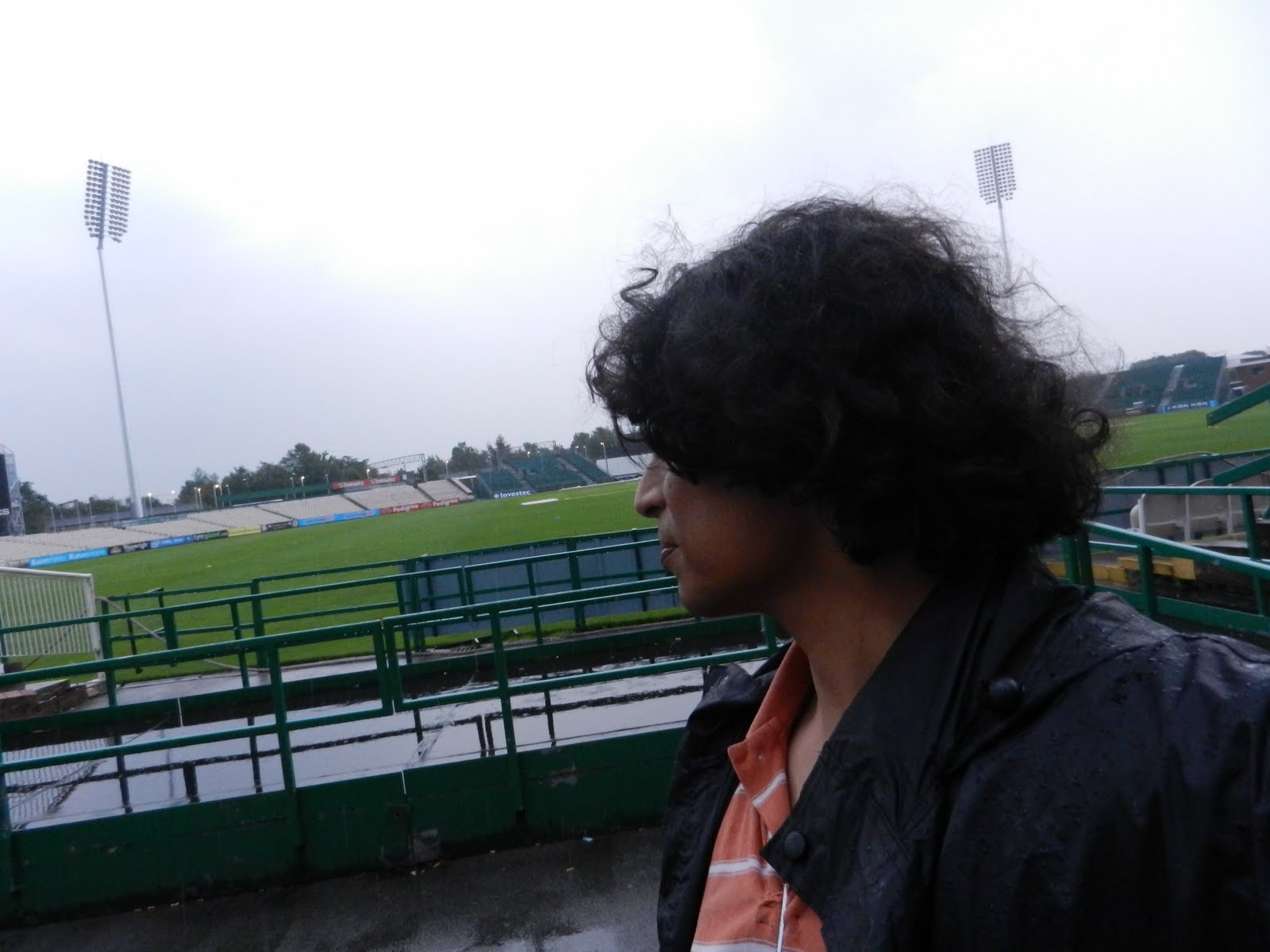
There is none of the preservation of tradition as I had found in the Headingley Lodge. The only cricketer I come across is a too large, too glossy and too colour printed version of Andrew Flintoff smiling away on the second floor.
There are signs of corporatisation everywhere. There is a business centre overlooking the ground, entrepreneurially named The Point, which can be rented for weddings. Surrounding the ground are utilitarian office blocks, although named after Statham, MacLaren and Duckworth. I jog down early in the morning and touch the turf, glance at the press box – also called the Neville Cardus gallery – but the rest of the place fail to make connection with the cricket romantic’s heart, let alone score a big hit. I leave after breakfast, as the car park of the ground, rented to adjoining office buildings, starts to fill up.
*
And now for the final stretch.
 |
| With two centurions at Oval - Gavaskar(1979) and Dravid (2011) |
But, today, I am the archer who has raised his bow and taken the aim of twenty years, time’s arrow stretched to the full, awaiting release, who cannot take his eye off the target, lest it disappears again.
 |
| The Book Shop |
Googlemaps misguide me. I end up taking a taxi from Epsom, while the Stoneleigh station is just a five minute walk from my destination. I reach at half past one. The brownstone shop for a minute reminds me of the fairy tale houses made of chocolates and biscuits. The sign – gold on green – announces, with a little bat for emphasis, J.W. McKenzie Cricket Books. It is mouth watering.
Sue is the lady I spoke to on the phone, dapper and charming, busy on the computer, cataloguing hundreds and hundreds of books perhaps. John McKenzie himself sits inside.
“Are you the one who had called?” he asks.
Around me are posters, prints, plates and other cricket collectibles. John is in his sixties, the moustache half hiding the smile of perpetual humour. He guides me to the room inside and I stand open mouthed. It is a small room, but with racks running around it along the walls and in between, every inch of the furniture stacked with books on nothing but cricket.
“Arranged alphabetically along the rows by author,” says John and soon decides to leave me in my wonderland. Three decades after my childhood I am in my own personalised ToysRUs.
 |
| Some Tea for my Troubles |
Arlott after Arlott stare at me from the starting shelf and I walk down the wall, heart beating faster and faster till it echoes off the centuries that are stored in the volumes. In that cramped room are stored thousands of cricketers, matches, opinions and anecdotes. Beanaud and Bradman smile their titles at me, I walk on further and discover the grail. Cosy and secure at the end of the wall stand a line of volumes with the magician’s name welcoming me with a smile. Australian Summer, Days in the Sun, Cardus in the Covers, Cardus on Cricket, A Fourth Innings with Cardus, Close of Play, Play Resumed with Cardus, Cardus for All Seasons, The Summer Game, Good Days ... and more. The veritable treasury of the master’s words I have been looking for all over Great Britain. And having found it, I am at a loss for words.
 |
| Problem of Plenty |
I scoop them up in my arms and make for the chair in the room. Even as I try to sit, I am blinded by the riches around me. From Jardine’s own account of the Bodyline Series, to the cricket writings of Winnie the Pooh creator A.A. Milne, every volume vies for my attention. The room, small though it is, is too large to carry in the luggage pit of an aircraft.
I sit in a trance, with the collection of Cardus and several more. How can I ignore Brightly Fades the Don, that immortal diary of Bradman’s 1948 tour of England by Jack Fingleton? What about Cricket My Destiny by Walter Hammond? And is it advisable to overlook A Life Worth Living the autobiography of C.B.Fry, the captain of English Cricket and Football teams, the world record setter in long jump, the classical scholar, the substitute delegate of the Indian representation in the first, third and fourth assemblies of the League of Nations, a man who was offered the Kingdom of Albania, and also wrote a speech which turned Mussolini out of Corfu? What about the books by Arlott, Swanton, Ray Robinson, Jack Hobbs, Denis Compton, Ian Peebles ...
 |
| John with Sue |
Sue thoughtfully offers me some tea, while I am still perplexed by the problem of plenty. I sip with growing disquiet. How does one choose which Cardus volumes to select? In his own words – we cannot measure genius with genius, you cannot try to place a Mozart over a Beethoven, a Bach above a Schubert. Each is an absolute. Of course, he was too modest to ever use the adjective while referring to himself. His autobiography is the most sublime demonstration of his thoroughly Newtonian view of every endeavour of life, collecting pebbles on the shore of wonder and standing on the shoulders of giants, drawing their portraits with words unmatched. It is for modern writers to jot down hasty thoughts about cricket while striving to appear the polymath. Cardus on the contrary created heady wine by fermenting on paper his own delight beside the green. By his statement about comparing genius he had questioned the wisdom of measuring the all round skills of Sir Garfield Sobers with Frank Wooley, Keith Miller and a few others.
An hour later, John checks on me. “Are you okay in here?”
I need time. Words vie with words for attention, from the shelf beside the chair I sit in, books piled in front of me, Keith Miller smiles rakishly, mane of hair tossed back.
“How long are you open?” I ask.
John smiles apologetically. “Normally till five and we are generally flexible. But, today’s Friday and there is a Test Match going on, I would rather close at four.” That gives me two more hours in Wonderland.
I walk to where John sits and ask him where the toilet is. He points to a wall covered with posters – “Just to the right of Bradman.”
Amongst treasures, I also dig up curiosities. Essays on cricket by E.V. Lucas. Two collections of cricket fiction written by the Who’s Who of English Literature, from Charles Dickens to Sir Arthur Conan Doyle, from Milne to Wodehouse.
In a corner, I catch sight of a bizarre novel by Stanley Shaw – in which Sherlock Holmes says, “Cricket is a mystery to me.” With Watson on his honeymoon, this tale is narrated by a 23 year old fair haired Australian named John Fairhurst, fresh off the boat in Britain, hoping to watch the immortal fifth Test Match played in 1902. History has it that on the final day at the Oval, when Gilbert Jessop turned it around for England, and Hirst and Rhodes stitched together a last wicket partnership to win it for the home side by one wicket. However, it seems the triumph would not have been possible but for the great detective, for Wilfred Rhodes would not have been present at the Oval.
I restrain my heart, control my mind and spur on my legs. Gathering up a tottering pile, I approach the desk where Sue sits in front of her computer. A dozen volumes, a trifle – nay, several notches – more than the budgeted volume and weight. However, I can always leave behind some of the inconsequential items of luggage, clothes and so forth.
“You really are a Cardus fan,” Sue beams. For the pile of treasure that I hold in my arms, it is a surprisingly paltry sum. John comes out of his coop and asks Sue to check the cricket score. Pietersen and Bell have piled on the plight for India. He is pleased.
 |
| With John in front of the shop |
John throws in a complimentary volume and two catalogues for free. He comes out of the
shop and obliges me by posing for a photograph. I take a last look at the shop and depart, with a silent promise to return, with eight volumes of Cardus and six more.
Quarter of a lifetime of search, and now I have the words of the man with me, in eight stout volumes. I sit in the returning train, caressing the collection.
“I desperately need to join Bibliomaniac’s Anonymous,” I call my wife and tell her.
She is innovative in response. “Let us design furniture with books.”
*
The evening spreads its shroud over the most fulfilling of my days. I sit, stretched out in the
Rainbow Quay flat of Suvro. He fingers the volumes with the tactile delight of an aesthete. The moment needs to be savoured with another soul who pines for the beauty of the loftiest of sports in these degenerate days.
It is a game that seems to me to take on the very colours of the passing months. In the spring the cricketers are fresh and eager, ambition within them breaks into bud; new bats and flannels as chaste as the April winds. The showers of May drive the players from the field, but soon they are back again, and every blade of grass around them is a jewel in the light.
What would Cardus have made of the modern game, when excessive squeezing of engagements in the cricket calendar ensures that cricketers are almost never fresh, when continuous cricket with an eye on the financials have almost done away with the concept of seasons?
My guess is that the romantic in him would have found eternal beauty even in the dust and debris of the modern game. To stitch together phrases of matchless eloquence to describe those adherents of the art of cricket untarnished by the murky wheel of time.
I can see him even now, watching from the Grand Stand of the Garden of Eden, filling his pen with soul and delighting the eternity beyond with his match reports - when Sachin batted a strange light was witnessed on the English fields, a light out of the East. Brian Lara, most masterful of batsmen, delights one and all, artists and statisticians, stroking the ball with a bat apparently itself alive, sensitive and powerful in turn.


